

Caroline Shinkle first came into my algorithm almost incidentally. She was standing off to the side of a small rally organized by End Jew Hatred, holding a sign. I didn’t know who she was, but she was difficult not to notice.
Caroline is often strikingly dressed, in Chanel style suits with immaculate hair, channeling a kind of Elle Woods energy into American politics. But the style is matched by substance. She is poised, articulate and policy-minded, with an impressive résumé and a way of communicating a pro-America, pro-Israel worldview that I found clear and compelling.
For a long time, whenever I watched her, I had the same thought: The only problem is that she’s a Republican. She’ll never win a congressional set in New York City.
But day by day I’m questioning whether that’s true.
There was a time when the R beside someone’s name was enough to stop the average Left-leaning person, but it seems like more and more decent, normal people like me have realised the world was morally inverted.
video credit: @sophiesrunway
In almost any other circumstance, I could look at someone like Caroline—her education, her experience, her competence—and think that this was exactly the kind of person who should be in Congress. But a Republican? No. Surely the Democratic Party could still correct itself. Surely there was enough political will inside the party to confront its extremists. Surely there were enough liberals who understood that opposing Donald Trump did not require surrendering every institution of American life to the ideological fringe. Surely there were enough people who believed antisemitism was antisemitism even when it came wrapped in the language of social justice.
I didn’t just believe this abstractly. I invested myself in it.
In 2024, I went to Minneapolis to volunteer and document Don Samuels’ Democratic primary challenge against Ilhan Omar. I believed there was a fight worth having inside the Democratic Party, because I believed there was enough decency, common sense and attachment to liberal democratic values within the political left to win that fight.
If you have been reading my essays over the past months, you have watched me wrestle with this in real time. I have written about the loneliness of trying to remain a bridge while the people on either side seem increasingly determined to burn it down. I have written about gay institutions and cultural spaces that once understood themselves as proudly liberal and somehow became vehicles for a politics that treats Israel as uniquely evil. I have written about celebrities and comedians who, in my view, abandoned moral clarity the moment that clarity became socially inconvenient.
Again and again, I kept coming back to essentially the same conclusion: I didn’t become political. Reality did.
But underneath all of those essays was an assumption I had never completely surrendered. I thought this could be corrected. I thought there were enough people inside the Democratic Party who would eventually look around at what was happening and say: Enough.
Over the past two years, however, I have found that belief increasingly difficult to maintain.
We Were There
Part of what makes this so personal to me is that I was in New York City. We were actually there.
We watched what happened to the city after October 7. We watched the demonstrations, the rhetoric and the intimidation. We watched Jewish New Yorkers move through streets where slogans ostensibly directed at Israel often felt, to many of us, increasingly indistinguishable from hostility toward Jews themselves.
This was not something I experienced through cable news or an Instagram algorithm. I lived there. I went to the rallies. I watched the culture change around me.
And Zohran Mamdani did not suddenly discover this political movement when he became a serious candidate for mayor. His activism around Israel and Palestine long predated his mayoral campaign. That politics subsequently became part of a much larger progressive movement in New York, one that succeeded not only in occupying streets and cultural institutions but in electing candidates.
That is what I think people outside New York City sometimes fail to understand. We watched something move from activism to culture to political power.
And now, even after everything that has happened. After a ceasefire in Gaza in effect for nearly a year, after watching the body of the final hostage Master Sgt. Ran Gvili recovered & returned, after 2 Wars against the IRGC —- the lies, subversion, delusion and hysteria continues.
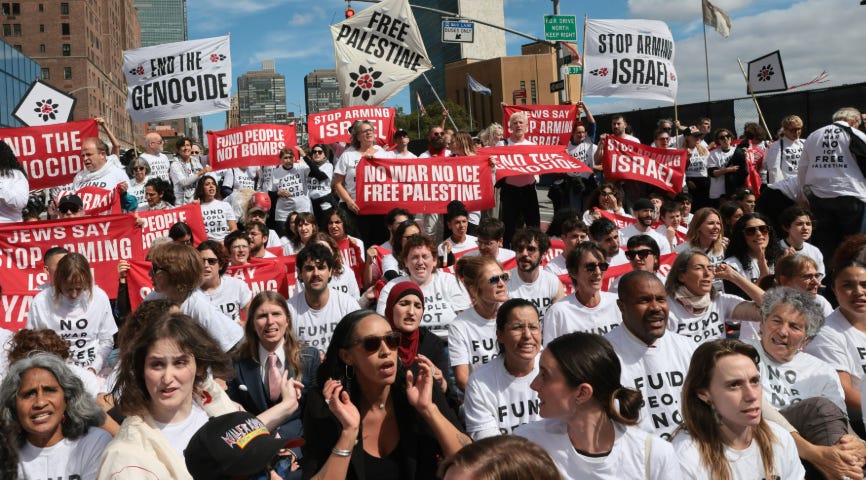
Just this week, Susan Sarandon, Hannah Einbinder and New York City Council Member Chi Ossé were among those arrested at a Jewish Voice for Peace-led demonstration outside the United Nations protesting Benjamin Netanyahu and American support for Israel.
At some point I find myself asking: when is enough actually enough?
When are there political consequences? When does somebody inside the Democratic Party rebuke this? When does the movement encounter a boundary rather than another rationalization?
Where are the boundaries of the political coalition they belong to?
Because boundaries tell you what a movement actually believes. If there is always another explanation, another qualification, another reason that this particular person or this particular slogan or this particular alliance should not count, then eventually the absence of a boundary becomes the political position itself.
Then Kamala Harris Went to Michigan
For me, the straw that broke the camel’s back came when Kamala Harris went to Michigan to campaign for Abdul El-Sayed.
Harris endorsed El-Sayed after he won the Democratic Senate primary and appeared alongside him in Detroit on September 22 as Democrats sought to unite the party behind his candidacy.
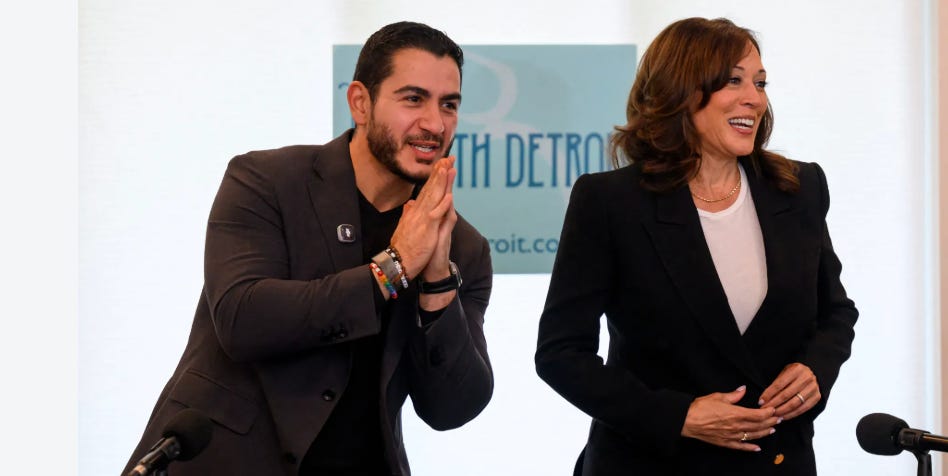
The symbolism of that mattered to me because the Democratic Party has had opportunity after opportunity to decide where its boundaries are.
It could confront antizionism on the left without immediately treating every objection as an attempt to silence criticism of Israel. It could take seriously the profound alienation many Jewish & Christian Americans feel from a political movement they spent generations helping to build. It could distinguish criticism of an Israeli government from a politics that regards Zionism itself—the idea that Jews are entitled to national self-determination in their ancestral homeland—as uniquely illegitimate.
And yes, that means being willing to confront Jews who participate in that politics too.
Jon Stewart. Ilana Glazer. Hannah Einbinder.
I know how incendiary the word betrayal sounds, and I use it deliberately.
If you believe that people within your political coalition have excused terrorism, minimized the threat posed by the Islamic Republic, demanded pressure on Israel while Israeli hostages remained in captivity, or transformed Zionism into a dirty word, and you nevertheless continue lending that coalition your cultural credibility because you prefer its domestic political program, then eventually you have made a choice about what you are willing to sacrifice.
If the promise of cheaper housing, greater social programs, ideological belonging or a socialist political project matters more to you than confronting what you believe is happening to your own people, then yes, I consider that a betrayal. You have decided that Jewish vulnerability is an acceptable price for the political future you want.
That is a bargain I am no longer willing to make.
Iran
That feeling intensified when I watched an Iranian-American confront Abdul El-Sayed about Iran.
El-Sayed has become a focal point for precisely these tensions within the Democratic coalition; his positions on Israel and U.S. foreign policy have generated significant disagreement among Jewish Democrats in Michigan even as party leaders, including Harris, have rallied behind him as the Democratic nominee.
I understand the argument against American military intervention.
But there is a distinction between foreign-imposed regime change and foreign support for people trying to change their own regime.
The Iranian people are not props in an American ideological argument. If Iranians themselves are fighting to change the terrorist organization that occupies them, their struggle does not suddenly become illegitimate because the United States might also benefit strategically from the result. Sometimes interests align. A different government in Iran will benefit Iranians while also benefiting Americans and Israelis and transforming the strategic landscape of the Middle East.
That isn’t sinister. That’s geopolitics.
And I have spent years now listening to people explain why the thing directly in front of my face isn’t actually happening.
Judge Judy had a rather less academic formulation: Don’t piss on my leg and tell me it’s raining.
“But Donald Trump…”
The answer to all of this is inevitably Donald Trump.
We have to resist Donald Trump. We have to save America from Donald Trump.
Fine. Oppose him. Criticize him. Protest him. Vote against him. That is democracy.
But at some point Democrats also have to confront the uncomfortable reality that Donald Trump won an election in which immigration and the economy were among the issues his own voters considered most important. That does not mean every American supported his program then, and it certainly does not mean every American supports his presidency now. But it does mean that millions of Americans knew broadly what they were voting for and voted for it anyway.
Many Americans want secure borders and national sovereignty. They want the opportunity to work hard, be paid well, buy homes and build families. Many remain attached to religion. Many have concerns about what their children are being taught. Many distrust institutions that they believe have stopped listening to them.
You can disagree with any or all of those concerns. But dismissing them as stupidity, bigotry or manipulation does not make them disappear.
At some point, people stop accepting the explanation and start believing their own eyes.
The Letter Beside the Name
Which brings me back to Caroline Shinkle.
This isn’t really an essay about becoming a Republican. It isn’t even really an essay about Caroline. It is about the moment when loyalty to a political tribe begins requiring you to deny what you believe you can plainly see.
I used to think it was still possible to find the reasonable Democrat. Support the primary challenger. Explain antisemitism one more time. Explain Israel one more time. Explain Iran one more time. Explain why liberalism cannot survive if truth becomes subordinate to maintaining a political coalition.
I did that. I wrote about it. I traveled across America and supported people I believed represented an alternative. And underneath all of it, I kept waiting for someone to draw a line.
Perhaps that is why Caroline Shinkle’s candidacy in New York’s 12th Congressional District means something different to me now. She is running as the Republican candidate against Democratic nominee Micah Lasher.
I cannot vote in that election. The people of New York’s 12th District will have to examine both candidates, their records and their policies and decide for themselves what they want their representation to look like.
But elections also reveal where voters draw their boundaries. And after years of watching a political movement move from the streets of New York into its cultural institutions and elected offices, I find myself wondering when the people who disagree with that movement will finally decide that they have seen enough.
When does somebody get rebuked? When does somebody pay a political price? When does a political party understand that the loyalty of the people who have traditionally supported it cannot simply be assumed?
That is why Kamala Harris campaigning for Abdul El-Sayed felt so significant to me. It wasn’t the beginning of this story. It was the end of an argument I had been having with myself for three years.
And perhaps that is the question I am left with now—not only for Jews, and not only for Democrats, but for anyone who has ever remained loyal to a political tribe long after it began making them uncomfortable:
How many things are you expected to swallow in order to remain part of the coalition? How many explanations do you accept? How many double standards do you tolerate? How many times do you watch someone cross what you once considered an uncrossable line before you begin to wonder whether the line itself has disappeared?
At what point does loyalty become complicity?
And how far does the line have to move before you finally stop moving with it?
For me, the straw has finally broken the camel’s back.
UPGRADE TO PAID SUBSCRIPTION 100$/yr